
Project objectives
Scientific Objectives
- Map the genetic structure selected common meadow herbs used in regional seed mixtures and describe the spatial patterns of their variability across the Czech Republic.
- Evaluate isolation-by-distance (IBD) and determine the extent to which geographic distance influences the genetic similarity of populations of individual species.
- Obtain a detailed overview of ploidy variability in polyploid complexes and map the spatial distribution of ploidy levels.

Applied Objectives
(Baseline for regional mixtures, conservation of genetic resources)
- Provide scientifically substantiated data for the creation of regional seed mixtures that respect the actual genetic structure of individual species.
- Identify areas where seed transfer is safe, as well as locations where it could disrupt local genetic patterns or lead to reduced fitness in newly established populations.
- Propose recommendations for handling polyploid species ***, including the necessity to strictly differentiate and separate individual ploidy levels (in line with findings by Höfner 2026) to prevent reproductive barriers and population decline.
- Support ecological restoration practices so that they utilize genetically appropriate, regionally adapted seed sources and minimize risks associated with the unsuitable mixing of populations or ploidy levels.
*** Information on the spatial distribution of ploidy is crucial in polyploid complexes, as mixing different ploidy levels can lead to reproductive barriers and weaken newly established populations. Based on our results and the conclusions of Höfner et al. (2026), we recommend strictly distinguishing and keeping individual ploidy levels separate to avoid disrupting local genetic patterns.
Context and Continuity
Our project builds directly on the extensive German research project RegioDiv (Walter Durka et al.), which was the first to systematically map the genetic variability of meadow species across Germany and test how well the genetic structure aligns with the designated seed regions of origin.
Analyses demonstrated that meadow species vary significantly in their degree of genetic differentiation. On one end of the spectrum are species with low variability, such as Tall Oat-grass (Arrhenatherum elatius), a historically widely sown grass, in which only two weakly defined genetic groups were detected.


On the other end are species with a highly pronounced structure, such as Common Agrimony (Agrimonia eupatoria), which exhibits six sharply segregated groups. These differences reflect the ecological requirements of individual species, their pollination syndromes, as well as the historical development of populations during glacial periods and post-glacial migration. Furthermore, in many species, the genetic groups line up spatially along north-south, east-west, or combined gradients.
Particularly the east-west gradient was surprising, as it does not correspond to the current demarcation of the seed regions of origin. In the Alpine foothills, for instance, a genetic division into a western and an eastern part was revealed, whereas the boundaries between the foothills and mountain regions, conversely, become blurred.
Illustration Note: Expert proposal for dividing Germany into 19 regions (color-coded) as a compromise between an algorithmic solution and minimizing changes to boundaries (thick lines indicate the boundaries of the current 22 regions).
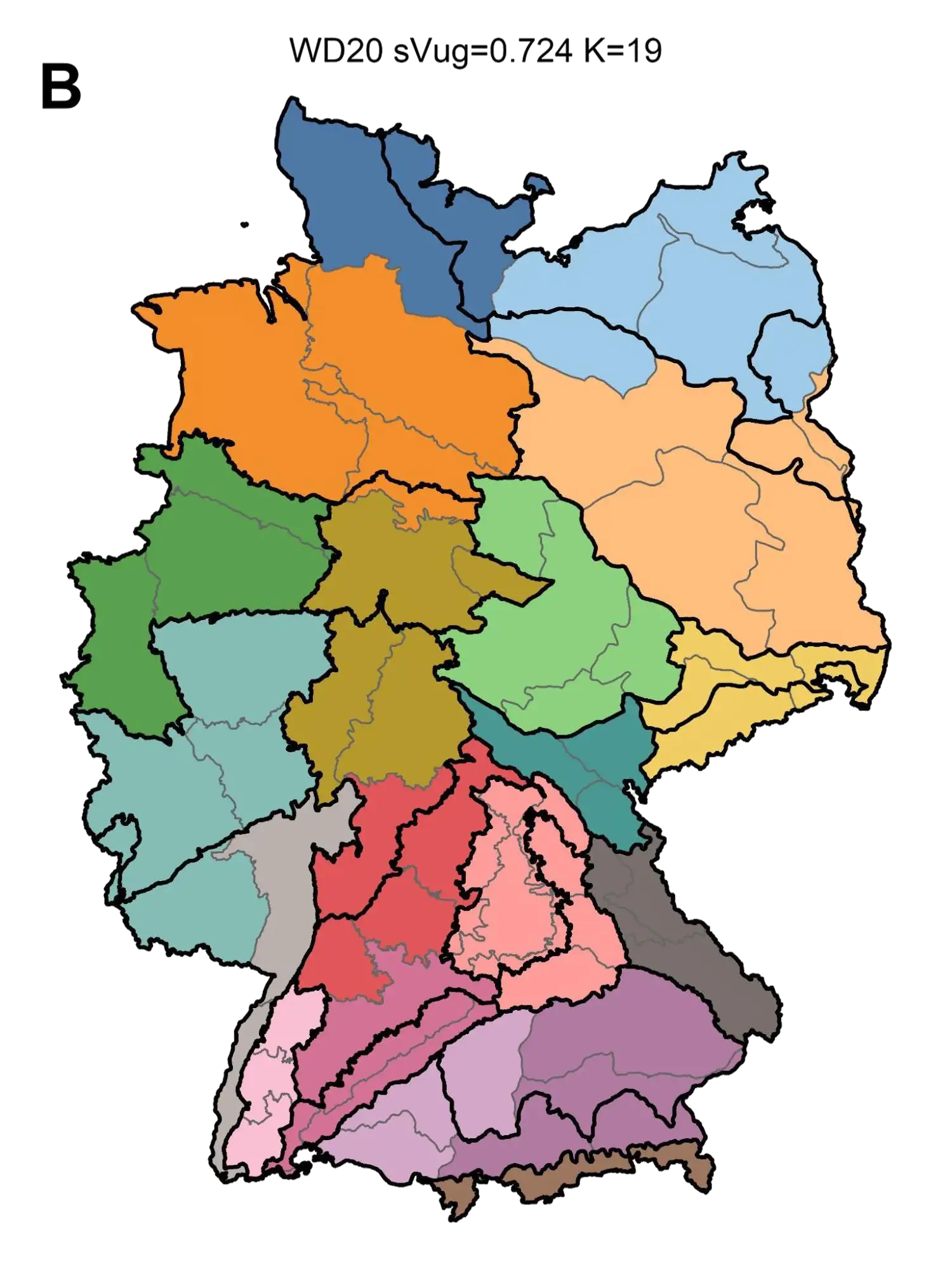

Additionally, it was found that genetic similarity decreases with increasing geographic distance (so-called isolation-by-distance), and the intensity of this relationship varies among species.
These results confirm that the regional origin of seed has a biological foundation and that transferring seed between distant areas can be risky, especially for species with pronounced genetic differentiation. The maps of genetic structure generated from the analyses show where seed transfer is appropriate and where it could lead to the disruption of local populations. At the same time, RegioDiv showed that genetic structure can exhibit different spatial patterns than administratively determined regions. It thus provided a valuable methodological framework for a scientifically sound delineation of source regions.
Our study follows this approach: we utilize a similarly dense collection network, modern genomic methods, and population structure analyses to describe the genetic variability of meadow species in the Czech Republic and to create baselines for regional seed mixtures based on actual biological reality.
The results of the RegioDiv project as well as our own project are featured in the article “Není kopretina jako kopretina aneb Genetická diverzita lučních druhů a regionální osevní směsi” (Not all daisies are the same, or Genetic diversity of meadow species and regional seed mixtures) published in the journal Živa 2/2025.
Consortia and Team
Institutions
- Institute of Botany of the Czech Academy of Sciences (AV ČR)
- Department of Botany, Faculty of Science, Charles University (PřF UK)
- In cooperation with: Czech Union for Nature Conservation (ČSOP – Mgr. Tereza Flečková, RNDr. Ivana Jongepierová)
Team Members
- Tomáš Herben, Institute of Botany AV ČR / Department of Botany PřF UK – tomas.herben@ibot.cas.cz
- Tomáš Fér, Department of Botany PřF UK – tomas.fer@natur.cuni.cz
- Jindřich Chrtek, Department of Botany PřF UK / Institute of Botany AV ČR – jindrich.chrtek@ibot.cas.cz
- Katerina Iberl, Department of Botany PřF UK – iberl@seznam.cz
- Martin Prach, Department of Botany PřF UK – prachmartin@gmail.com
- Hana Skálová, Institute of Botany AV ČR – hana.skalova@ibot.cas.cz
Funding acknowledgement: This project is supported by the Technology Agency of the Czech Republic (TA ČR) under the SS – Applied Research, Experimental Development and Innovation Programme in the Field of Environment – Environment for Life, Project No. SS07010388, 04/2024 – 12/2026.
Data Protection
All genetic, ecological, and other data presented within this project are protected by copyright and are used exclusively for scientific and professional purposes. Published samples of research results represent illustrative analysis outputs and must not be further distributed, modified, or commercially used without prior consent from the research team. The published information does not contain any personal or sensitive data. Geographical information is presented only in a format that does not allow for the identification of specific landowners or other entities.
Ethical Principles and Legislation
All field collections of plant material were carried out in compliance with the valid legislation of the Czech Republic, particularly Act No. 114/1992 Coll., on the Protection of Nature and the Landscape. The collection involved common species that are not legally protected, and therefore no special permits were required. Sampling was conducted carefully, on a small scale, and in a manner that does not affect the vitality or long-term stability of the populations.
The project adheres to the principles of ethical management of genetic resources, including minimizing interference with natural habitats and respecting the ecological integrity of the sites.